


Destination resorts
A destination resort is not weighing whether it can afford equipment. It is weighing whether an outside operator can run a guest-facing amenity to its brand standard.
You are not worried about the cost of the equipment
Most of this industry opens by telling you the machines are free. For a destination resort that is beside the point. You could buy the equipment tomorrow. What you are actually weighing is whether to hand a revenue-generating guest amenity to an outside operator, and whether that operator can run it to your brand standard in front of your guests.
That is a harder question and a fairer one, so this page argues on those terms.

What running a resort-scale attraction actually requires
A staffed arcade at a destination property is a small business operating inside your business. These are the parts that go wrong when the operator is out of their depth.
Staffing to a hospitality standard
Uniformed, trained, scheduled to your activity hours, and briefed on how your property handles a guest complaint. Arcade staff are guest-facing staff. Guests do not distinguish between your employees and ours.
Guest recovery authority
Floor staff who can resolve a stuck credit or a failed redemption on the spot, without escalating to a manager who is not on site. Most disputes are worth a few dollars and cost far more than that in goodwill.
Presentation and cleanliness
Screens working, prize wall stocked, carpet clean, nothing out of order with a paper sign taped to it. A tired arcade reflects on the resort, not on the operator.
Peak-period capacity
Holiday weeks and wet afternoons are when the room either performs or embarrasses you. Staffing and float have to be sized for the peak, not the average.
Integration with your systems
Room charging, resort credit, wristbands and loyalty tie-ins where your platform supports them, so the arcade is part of the stay rather than a separate transaction.
Reporting you can audit
Gross by period, by machine, reconcilable against your own footfall. You can request it at any time, without a portal login or a support ticket.
Percentage rent, not a placement fee
At resort scale the arrangement is normally structured as percentage rent: the resort takes a percentage of gross, and General Vending carries the equipment, the staffing, the stock and the operating risk.
Typically 25–30% of gross revenue, paid to the location as percentage rent, with the position inside that band set by the size of the footprint, the staffing model, the length of term and how much of the build-out each side funds.
Applies where property scale justifies the staffing investment — roughly 400–800+ rooms, or equivalent guest volume.
This is a different structure from the per-category splits that apply to unstaffed placements. Those are published in full on our revenue share page, and the same principle applies here: you see the structure before you negotiate, not after.
What sits inside the percentage
- Equipment purchase, delivery, installation and refresh
- Arcade staffing, training and scheduling
- Prize and redemption stock
- Daily cleaning and technical maintenance
- Card systems, readers and payment infrastructure
- Reporting, reconciliation and audit support
Build-out contribution and term length are the two variables that move the percentage most.
Two decades at a resort-scale Orlando property
We have run the amusement operation at a large Orlando convention hotel for more than twenty years, through multiple changes of management on the property side. Length of relationship is the only credential that cannot be manufactured for a pitch.
What it produced is more telling than the duration. The property came to use game-room comp cards as a service recovery tool — when a guest had a bad experience, the front desk handed them arcade credit to put it right. That only happens once a resort trusts an operator enough to make them part of how it repairs its own guest relationships.
Property name omitted as a matter of standing policy.
The variables that actually move the number
We don't publish a calculator, because a number produced by five dropdowns would be a guess dressed up as a forecast. These are the factors that genuinely decide what a destination resorts placement earns.
- Captive guest nights All-inclusive and on-site-stay properties concentrate spend inside the gates. Occupancy times length of stay is the number that matters.
- Family mix The proportion of bookings traveling with children under 16 changes the equipment mix and the revenue profile entirely.
- Programming and hours A staffed room open to match resort activity hours performs on a different scale from an unattended alcove.
- Footprint and adjacency Square footage matters, but proximity to pools, food outlets and evening entertainment matters more.
- Brand standards Uniform, signage, cleanliness and guest recovery are part of the revenue equation at this scale, not a side concern.
Give us a conversation and we'll model it properly
Tell us your traffic, your layout and your hours, and we'll build a realistic projection against comparable placements — not a slider. If the numbers don't work for your property, we'll tell you that too.
Reliability is the product
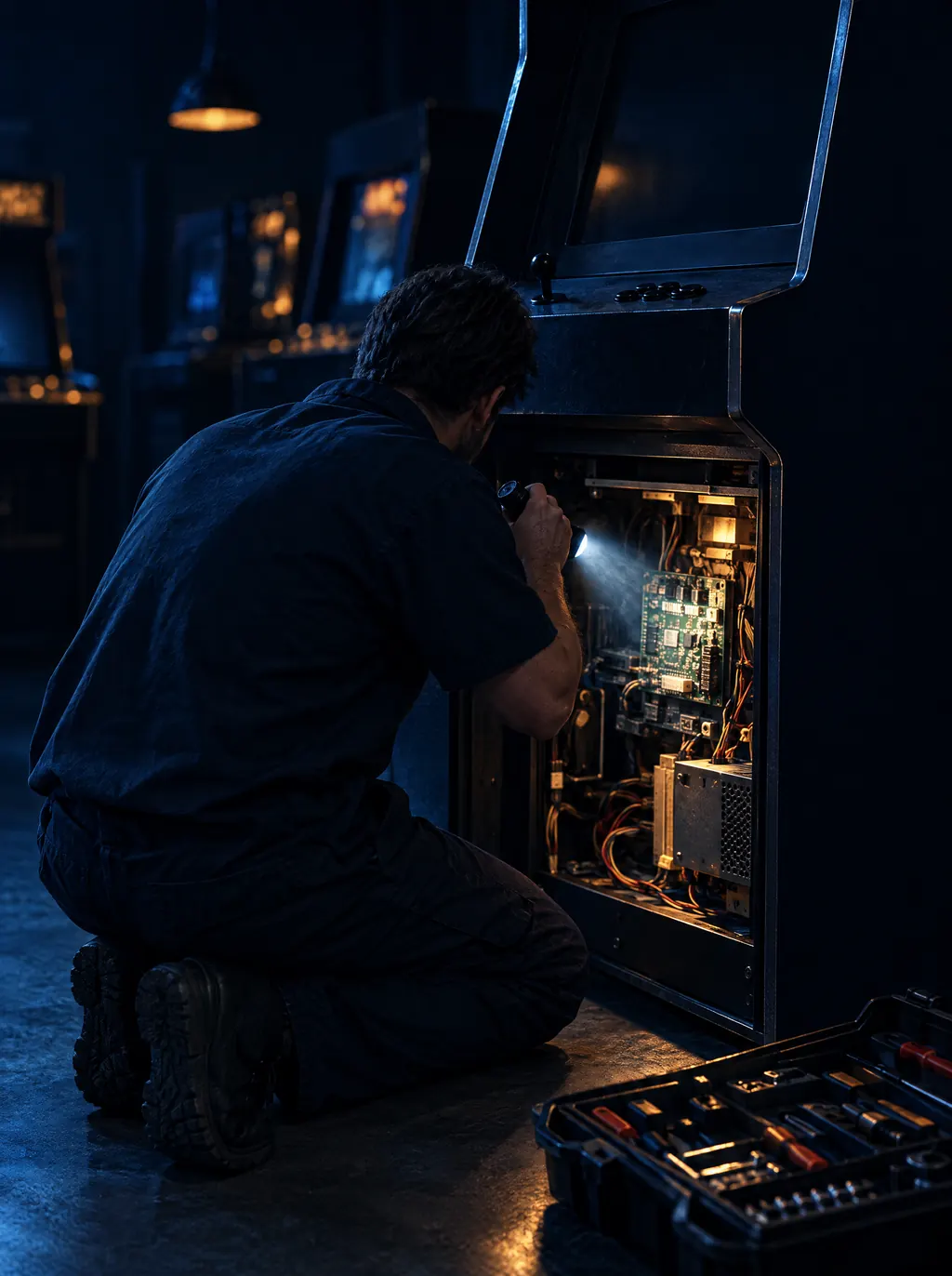
Equipment earns nothing while it is out of service. Everything else — the split, the titles, the payment technology — only matters if the machines are working when your guests walk past them.
- Service requests are received 24/7. A QR code on every machine opens a form that takes about two taps.
- Response is prioritized by urgency. A jukebox down in a full bar on a Friday night gets someone moving within minutes. A jammed bill acceptor at 4am gets logged and handled first thing — we don't pretend otherwise.
- Your problem is logged the moment it happens and triaged the moment it matters. That is a more honest promise than "next business day", and in practice a faster one.
- Remote monitoring on supported equipment means we often know before you do.
Partner, not vendor
Tell us about your location. If we can make it work we'll show you the numbers, and if we can't we'll say so. Either way you get a straight answer.