


Restaurants, QSR and national chains
A custom amusement program, carrying your brand, rolled out across an entire estate. Franchisees get a new revenue line at zero cost. The franchisor gets a percentage of it as a new top-line stream.
A new top-line stream that costs your franchisees nothing
Most amusement conversations happen one restaurant at a time, with a local operator and a general manager. That is not this. This is a custom amusement program, carrying your brand, designed once and rolled out across an entire estate.
The franchisee gets a new revenue line with no capital outlay and no operational burden. The franchisor takes a percentage of what franchisees earn — a new stream on top of royalties, generated by space the estate already owns and currently gives away.
Three parties, one program
-
The franchisor defines the program
Equipment mix, cabinet artwork, on-screen branding, characters, and any loyalty or app tie-in. It is specified once, centrally, so a guest gets the same experience in every location — which is the entire reason a franchise system exists.
-
General Vending funds and operates it
We buy the equipment, produce the branded build-out, install it, service it and refresh it. Rollout is scheduled by region so it does not disrupt trade, and every unit is on the same standard and the same reporting.
-
The franchisee earns from day one
No capital request to a franchisee who has just paid for a build-out. No staff time — collections, faults and cash are ours. A published revenue share on gross, reported per location.
-
The franchisor takes a share of the estate
A percentage of franchisee earnings across the network, flowing to the brand as a new top-line stream. It scales with unit count, and it grows when the program performs rather than when franchisees are charged more.
The equipment is estate-wide media you get paid to install
Brand reinforcement
A cabinet wrapped in your identity, with your characters on screen, is brand exposure at eye level during the exact minutes a guest is bored and looking for something to read.
Family dwell without cost
Waiting families are the hardest group to hold and the easiest to lose to a competitor across the parking lot. Amusement converts that wait into tolerance, and tolerance into covers.
Loyalty integration
Where your app supports it, game credit becomes a loyalty reward that costs the brand far less than discounting food and does not train guests to wait for offers.
Consistent guest experience
One specification, one operator, one service standard across every unit — instead of whatever each local franchisee happened to sign.
Central reporting
Performance by unit, by region and estate-wide. Underperforming placements are visible and fixable rather than invisible.
Franchisee goodwill
A program that pays franchisees rather than charging them is unusual enough to be an easy sell at a franchise conference.
Sized to the service model
Quick service, fast casual and full service have completely different dwell profiles, and the same program cannot serve all three unchanged.
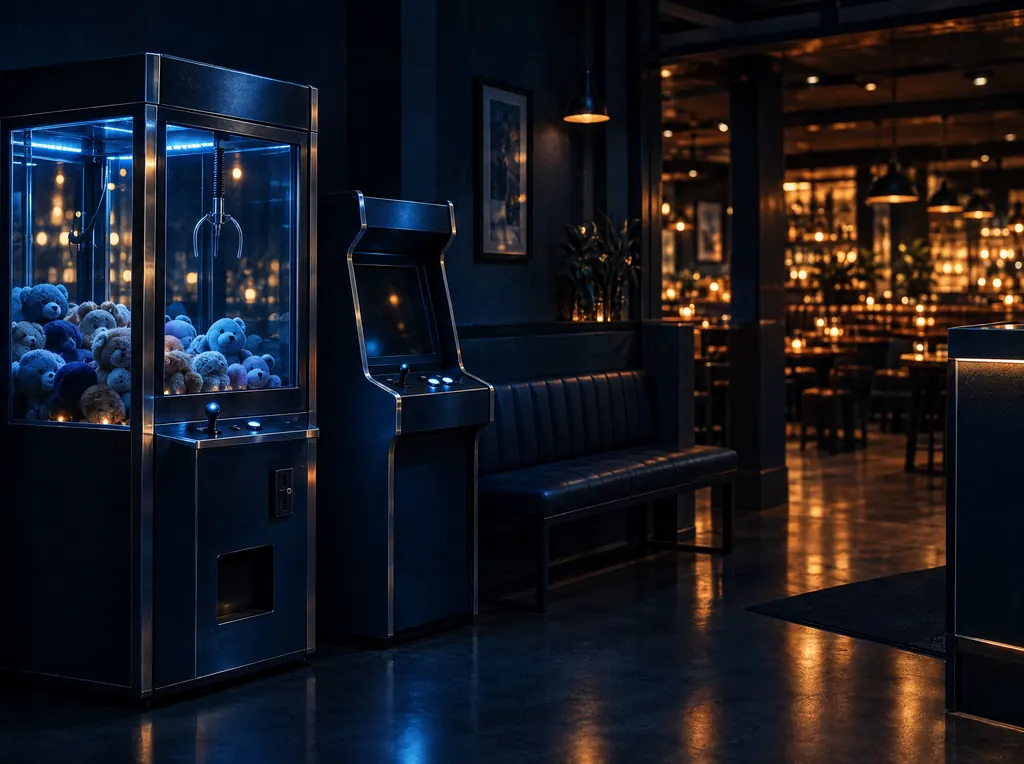
- Quick service — compact and countertop formats in the queue and collection area, built for short sessions.
- Fast casual — a small placement near seating, for the gap between ordering and food arriving.
- Full service — a defined waiting-area zone, which is where the largest share of restaurant amusement revenue is earned.
- Destination and entertainment dining — a full game room operated as its own profit center. See entertainment venues.
Starting a conversation
Rollouts start with a small number of pilot units, measured against controls, before anything goes estate-wide. If the pilot does not perform we will tell you, and there is no obligation to proceed.
The contact form has a number-of-locations field — fill that in and it reaches the right person directly.
The variables that actually move the number
We don't publish a calculator, because a number produced by five dropdowns would be a guess dressed up as a forecast. These are the factors that genuinely decide what a restaurants, qsr and national chains placement earns.
- Estate size and density Unit count sets the scale; geographic clustering sets the service economics.
- Average dwell time Quick-service and casual dining sit at opposite ends, and the equipment mix has to follow.
- Family share of covers The proportion of tables with children is the strongest single predictor of amusement revenue in dining.
- Waiting area footprint Lobby and queue space is where a QSR program earns. Dining-room placement performs differently.
- Brand integration depth Generic equipment earns. Equipment wrapped in your brand, with your characters and your loyalty tie-in, earns more and reinforces the brand while it does it.
Give us a conversation and we'll model it properly
Tell us your traffic, your layout and your hours, and we'll build a realistic projection against comparable placements — not a slider. If the numbers don't work for your property, we'll tell you that too.
Reliability is the product
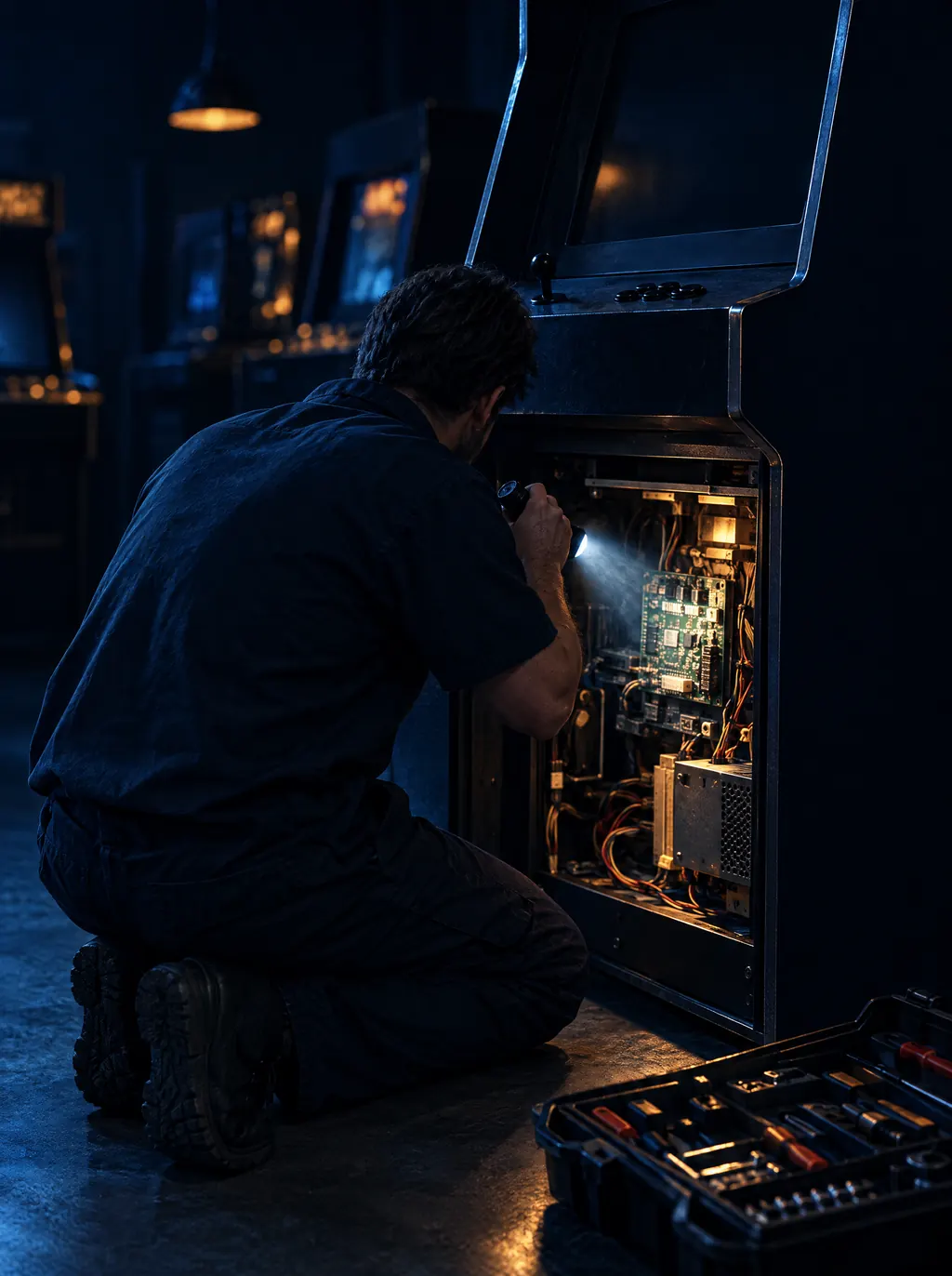
Equipment earns nothing while it is out of service. Everything else — the split, the titles, the payment technology — only matters if the machines are working when your guests walk past them.
- Service requests are received 24/7. A QR code on every machine opens a form that takes about two taps.
- Response is prioritized by urgency. A jukebox down in a full bar on a Friday night gets someone moving within minutes. A jammed bill acceptor at 4am gets logged and handled first thing — we don't pretend otherwise.
- Your problem is logged the moment it happens and triaged the moment it matters. That is a more honest promise than "next business day", and in practice a faster one.
- Remote monitoring on supported equipment means we often know before you do.
Partner, not vendor
Tell us about your location. If we can make it work we'll show you the numbers, and if we can't we'll say so. Either way you get a straight answer.